Galena Bicentennial | Celebrating 200 Years: An Amateur Historian Hits the Big Time
Since I’m a fiction writer with a passion for history, I normally treat history as a character I can manipulate as I please rather than through the analytic and documentary practices of a professional historian. I was suprised and pleased when after submitting my idea to the Galena Bicentennial Symposium Committee last Fall, I was invited to present it this May. My idea was to highlight middleclass St. Louis women of the early 19th century and examine why they moved to Galena and how they showed up. I got to do that as one of the first speakers at the Symposium on Saturday, May 16.
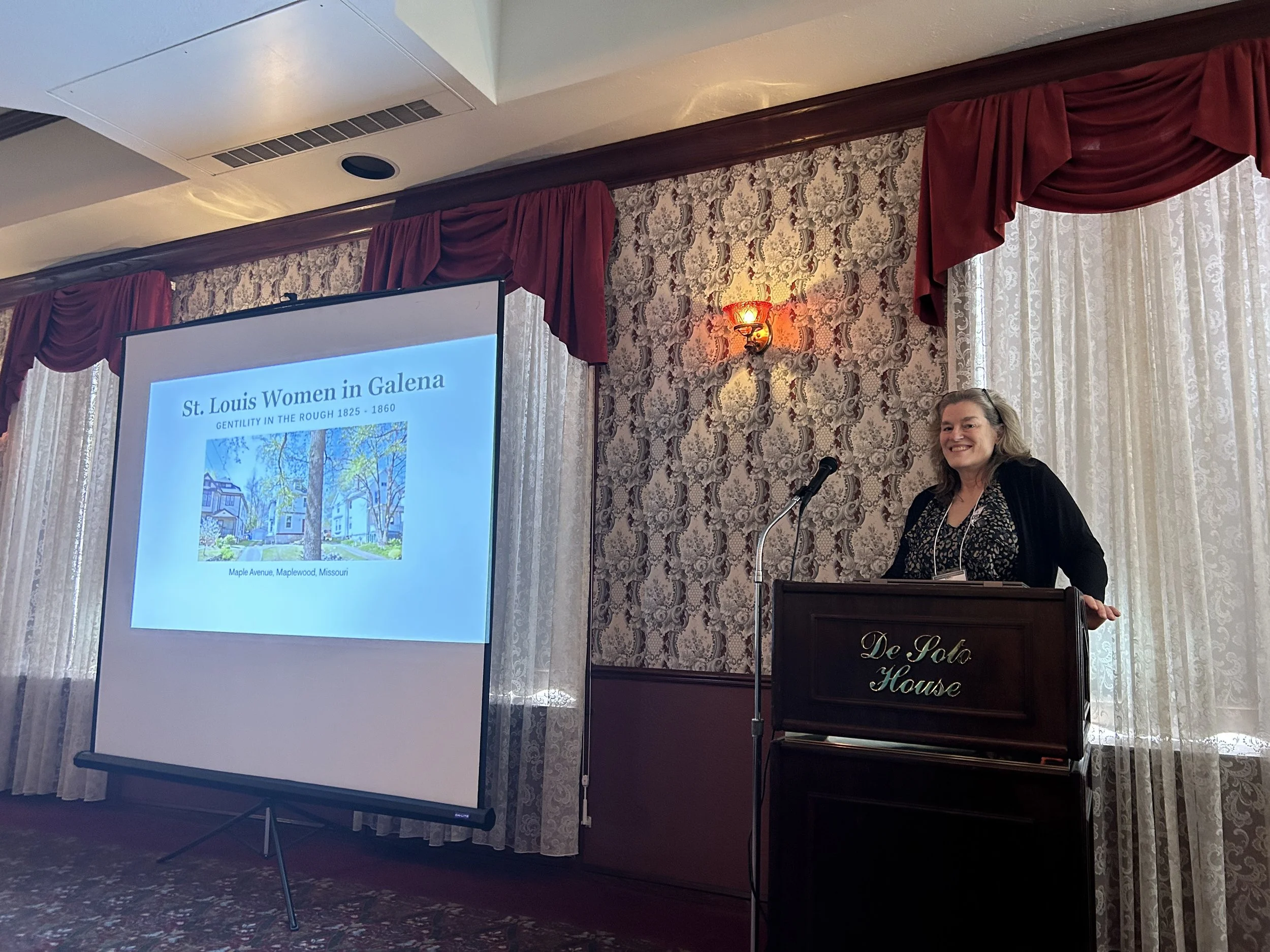
My relationship with Galena, Illinois is fairly new, but meaningful. Even though it is only a few miles from the southern border of my home state of Wisconsin, I visited for the first time as recently as 2023. I was on a mission to understand its historical and economic importance for the characters in my novel-in-progress, The Widow of Wood River. I wore the wrong shoes—strappy sandals—which meant that by stubornly hiking up and down the hundreds of steps between the terraced, old streets of the town, I ended up with painful blisters. I knew better this time.
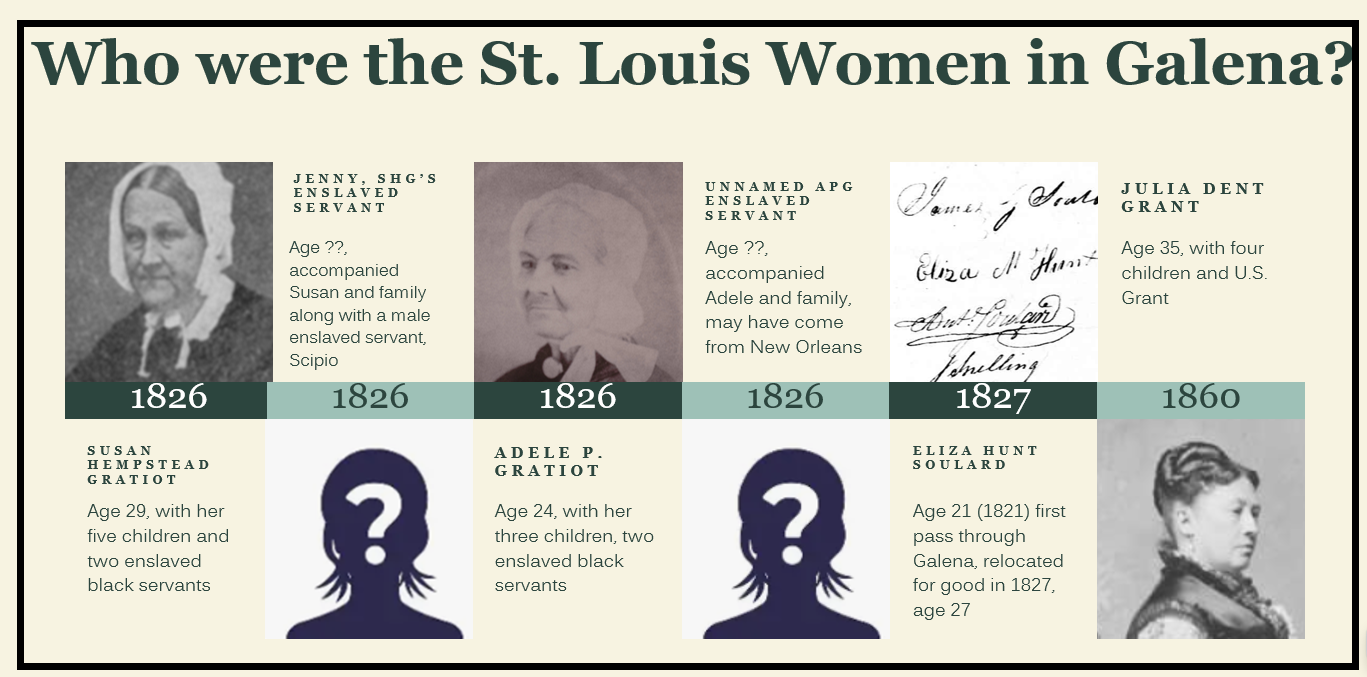
Middle class St. Louis women who moved to Galena, Illinois in the mid-1820s took enslaved servants. By 1860, when Julia Grant and her husband Ulysses S. Grant moved there, it was common knowledge that taking enslaved servants to the free state of Illinois was taking them to freedom. She left her four enslaved servants at home in Missouri.
I won’t repeat my talk here, but share above what I think was the most poignant slide. It identifies the middleclass white women and the enslaved servants they took from Missouri, where slavery was legal, to Illinois, where it was technically—if not practically—illegal.
I will share a discovery I made before my talk that made me feel like a real historian. Henry and JPB Gratiot are well known in Galena history for arriving from St. Louis in 1825, establishing themselves as leaders of the lead mining industry there, and establishing their own community known as Gratiot’s Grove several miles northwest of Galena, up the stagecoach road. Numerous secondary sources describe the eagerness of the Gratiot brothers to take the enslaved they controlled to a free state so they could free them for their safety; slavery being against Gratiot values. The sources describe a $1000 bond in the Jo Daviess County Courthouse representing the manumission of their slaves, which they acted upon as soon as they arrived, but none of the sources cite this reference specifically. I wanted to see for myself.
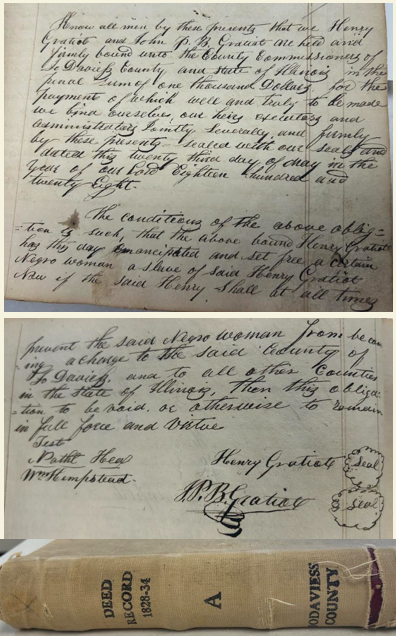
Manumission documentation to “set free a Negro woman” signed by Henry and JPB Gratiot, 1828, Jo Daviess County Deed Record Book A, 1828-34.
The kind and lovely people at the Jo Daviess County Courthouse had found the record for me before I arrived on Friday afternoon, and allowed me to photograph it from the 1828 record book, the first of the Jo Daviess County record books. It does indeed document the $1000 bond, specifically mentions that it was for the freedom of one unnamed black woman, and is dated 1828—three years after the Gratiots began establishing their Galena-based lead-mining business.
Since there are no preceding record books containing such documentation, I can’t say for sure that the Gratiot brothers didn’t free other slaves in the years between 1825 and 1828, but I can say that three years is a long time to delay freedom for an enslaved person you have brought to a free state for the purposes of doing the right thing.
The rest of the conference allowed me to hear from real historians about topics I am deeply interested in. Tracey Lee Roberts delivered a fascinating talk about Dr. Sarah Coates Harris, a phenom of science and medicine in Galena. Karen Sieber spoke about Moses Dickson—an unsung hero of abolition with St. Louis roots. Dr. Caitriona Terry brought to light the astounding life of Adele Gratiot Washburne, a niece and namesake of one of the women I spoke about, Adele Gratiot. The keynote speaker, Dr. Jennifer K. Stinson, delivered a talk summarizing concerns that were thematic of many of the talks I heard: How did Indiginous, Black, White and Immigrant Women make history in Galena?
I was literally blown away the panel that closed out the day: “Stories of the Land Through Time—An Indigenous Perspective on Galena’s History.” Organized by the Jo Daviess County Conservation Fund, the panel included Ho-Chunk Nation Preservation Representative Bill (Nąąwącekğize) Quackenbush, Cultural Resource Archaeologist Philip Millhouse and Steve Barg, Executive Director of the JDCF. Bill told the story of how the Ho-Chunk consider the area around Galena to have been the refuge of their ancestors when the last glaciers receded opposed to The Driftless area, the name of the land the glaciers “missed” in the anglo-european tradition. Phil spoke of his efforts to prevent sales of historic farmland to developers in favor of preserving its mounds. The purchase of the lands is made possible by the Fund, as explained by Steve. By representing the Ho-Chunk, archaeology, and funding, the panel presented a practical and impressive story of preservation and collaboration.
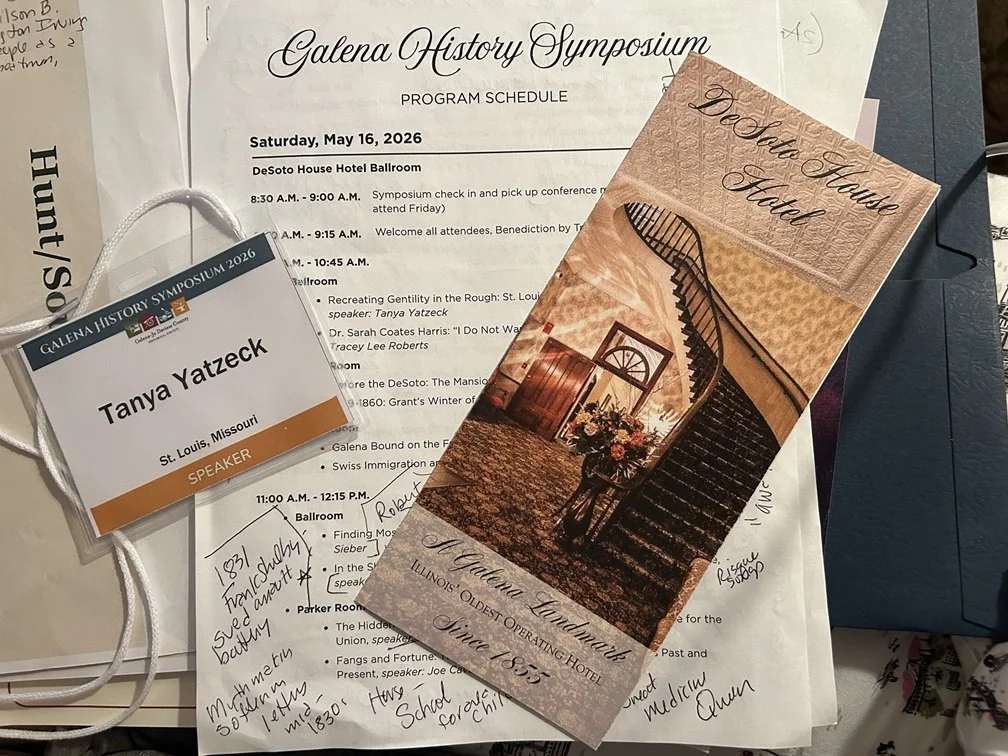
I splurged and stayed at the conference hotel, the historic De Soto House, which made my history-loving heart very happy. And it was, naturally, the perfect site for the event. My talk was well-received, and it seemed to generate significant interest in my fiction project. I can’t wait to deliver!